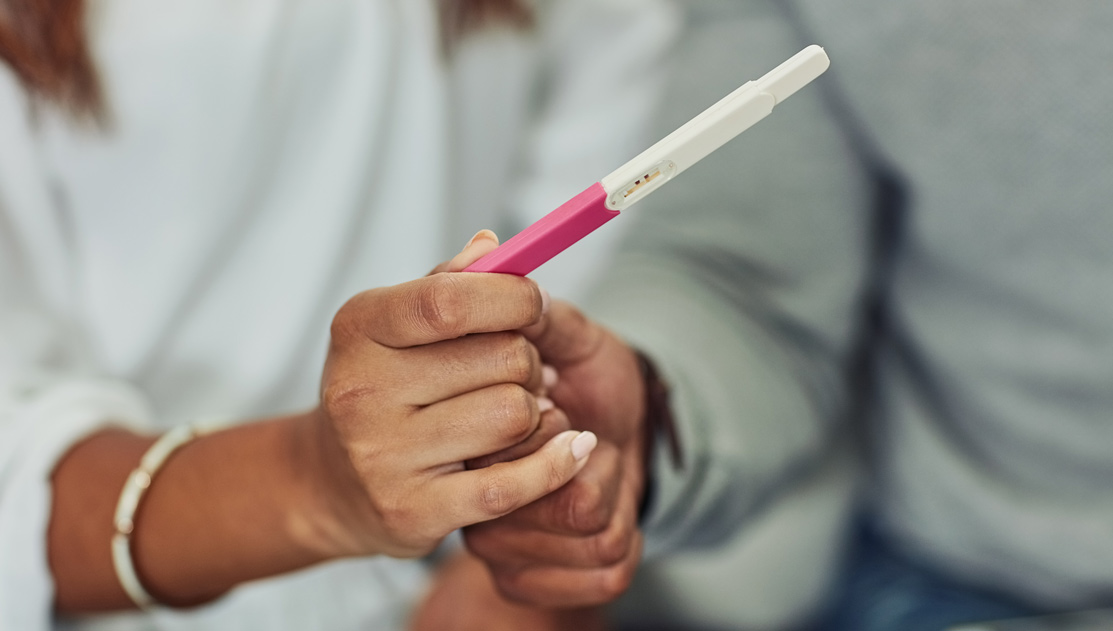




Have you been trying to get pregnant for a year or more? It’s time to talk about fertility testing. Read on to learn more.
The 12-month mark: What it means medically vs. emotionally
If you’ve been trying to get pregnant and have hit the 12-month mark, it probably feels like a heavy milestone. For many couples, it’s the point when expectant hope becomes persistent worry.
Many women report feeling like the word subfertile was slapped on them psychologically at that point, leaving them heartbroken.
But it’s important to take a breather. Yes, it’s the point at which the medical community starts to use the words ‘infertility’ and ‘subfertility’. But outcome-wise, that’s nowhere near the full picture.
Did you know that:
- Around 50% of couples who don’t get pregnant naturally within the first year of trying will go on to conceive in the second year
- New research has discovered that even among women who have had a baby via assisted conception (e.g. IVF), 1 in 5 have gone on to have natural pregnancies afterwards
So if you’ve been trying to get pregnant for a year, that in itself doesn’t mean natural conception is off the table.
Transitioning from ‘trying for a baby’ to ‘visiting a fertility doctor’ can feel scary and sad. But medically it just means it’s time to get checked out.
Boss your family-building journey the way you boss everything else
Look at this the way you look at other hurdles that crop up – in work, in finance, in logistics. You employ knowledge, problem-solving, and action.
At work when it looks as though there might be a roadblock, you do some information-gathering so you can find a way through. Trying to get pregnant is the same.
The 12-month mark is emotionally laden, but medically, it’s just an arbitrary threshold for fertility testing because a woman’s age is the single most important factor for fertility. This is due to the number of eggs in the ovaries; women have a finite number of eggs and there is no drug that can modify this. Yes you probably need to lick your wounds because it’s disappointing after trying to get pregnant for a year. But having an accurate picture of where you are gives you greater control. Is age really that important? We’ll let the numbers peak for themselves:
- The chance of a 30-year old woman getting pregnant each month is 20%
- The chance of a 40-year old woman getting pregnant each month is 8%
When should you seek help based on your age?:
- For women under 35: After 12 months of trying
- For women 35-40: Official guidance recommends after 6 months of trying but we suggest after 3 months
If you have irregular periods, known gynaecological conditions or medical issues, you should seek fertility guidance before the 12-month mark to optimise your health.
The sooner you get checked out, the closer you are to building the family you dream of.
In preparation for conception, it is recommended that you and your partner optimise your general health with positive lifestyle changes. This includes aiming for a healthy BMI, stopping smoking, exercising moderately, and maintaining a varied and nutrient-dense diet.
So what fertility tests do you need? Read on and we’ll break it down.
The essential first fertility tests for women (and men)
You’ve been trying to get pregnant for a year: What are the essential first fertility tests?
The honest answer is, at this point there are no ‘first’ fertility tests – only comprehensive fertility tests. That’s the only way to get a reliable picture of what’s going on. And even so, the exact tests will vary based on your own individual situation and any medical conditions you may have, like diabetes or epilepsy.
Fertility problems come in many forms – from sperm problems to abnormally shaped wombs, to hormonal imbalances, and even problems driven by suboptimal lifestyle habits. And you cannot tackle a problem until you identify it. Different fertility problems may call for different fertility treatments, so exacting fertility testing is key.
Dr Kale, Fertility Consultant, says: “These days you can get basic at-home blood tests measuring things like AMH that are marketed as a kind of ‘first fertility test’ for women – but when they aren’t accompanied by other essential checks they don’t mean much. In fact they could offer false reassurance.
“And false reassurance is particularly problematic because age is the single biggest factor affecting fertility. If there is another problem driving a couple’s fertility problems that goes undetected because the woman’s AMH levels are fine so they believe all is well, it’s just time wasted. And time is fertility. This is true for couples conceiving naturally or via assisted conception. The sooner you get to grips with any problems, the better.”
Here at The Fertility & Gynaecology, we offer comprehensive fertility testing packages for couples. This is the quickest and most cost-effective way to get a clear picture of what’s going on. A comprehensive fertility package at a good fertility clinic should include:
Thorough consultation with medical history
All sorts of lifestyle factors, medical conditions, and medications can impact fertility in ways that most people would never realise – because it isn’t a layperson’s job to know, it’s the doctor’s. For example: What’s your diet like? How are your stress levels? A proper fertility check should include detailed consultation and medical history taking. Good fertility doctors will ask the right questions and provide advice tailored to you.
Transvaginal ultrasound
With transvaginal ultrasound, fertility doctors can get a real-time picture of your reproductive organs and identify issues that could be causing fertility problems – from fibroids or cysts to problems with the uterine lining. It should also include an antral follicle count, which is where your follicles (little fluid-filled sacs containing immature eggs) can be counted. While blood AMH levels do indicate ovarian reserve, an antral follicle count allows doctors to get a better sense of how you might respond to egg stimulation (and hence how to tailor any fertility treatment, should you need it).
Blood testing
Blood testing helps ascertain your ovarian reserve (remaining eggs) by measuring your levels of AMH (anti-mullerian hormone). Blood testing can also be used to get a picture of the balance of other hormones vital for good fertility.
Saline Hysterography (SIS) aka Aqua Scan
Saline hysterography offers a more detailed picture of the inside of the womb as well as a clearer visualisation of possible fallopian tube obstructions. Embryo implantation failure or miscarriage can occur because of problems like blocked fallopian tubes, or abnormalities with the womb including scar tissue, adhesions (e.g. because of endometriosis) polyps or even a septum (a layer of tissue dividing the womb into two parts). The process involves inserting sterile saline into the womb with a catheter while the ultrasound is performed.
Semen analysis for the male partner
It is absolutely essential for the male partner to be thoroughly screened – we cannot stress this enough. Male subfertility alone accounts for up to 30% of all heterosexual couple subfertility. And an additional 30 to 40% when combined with female subfertility or unknown cause subfertility.
Semen analysis looks at sperm count, shape and motility, in addition to the seminal fluid’s general content. Advanced fertility screening can also screen for any suspected antisperm antibodies that can cause male subfertility (these are sometimes produced by the immune system in response to inflammation or trauma).
Explanation of the results in person and in writing
If you’ve been trying to get pregnant for a year or more, fertility testing can feel particularly emotionally laden. So you will want the detailed, often complex information from your fertility report delivered in compassionate, person-to-person form – with space to ask all your questions. What’s more, you will need a thorough written report to take away with you, so you can return to it as you talk through the results and consider your options.
We know it’s scary to undergo fertility testing, but try to take heart. Testing might discover everything looks fine. And if there are issues to contend with, there are now many advanced fertility medicine interventions that can help even couples with the most complex problems to have a baby of their own.
Remember that time is fertility. So the sooner any problems are uncovered, the better your chances of reaching your goals.
Here at The Fertility & Gynaecology Academy, our fertility testing leaves no stone unturned. With decades of experience, we are home to some of the UK’s leading fertility experts and state of the art testing technology.
To find out more or book a consultation call The Fertility & Gynaecology Academy now on 020 7224 1880 or email info@fertility-academy.co.uk.