

GLP-1 medications like Mounjaro and Wegovy have rapidly become part of everyday life. An estimated 1.9 million adults across Great Britain are now using them, with numbers having almost tripled in just two years, according to UCL. If you are one of them and are also thinking about starting a family, you are far from alone.
Wondering if there are conflicts between GLP-1 and fertility treatments? Or perhaps you’re already on a GLP-1 and want to start trying for a baby or seeking fertility treatment. Read on as we break down the current best practice on GLP-1 and fertility – and what you need to know to stay safe.
What are GLP-1 medications?
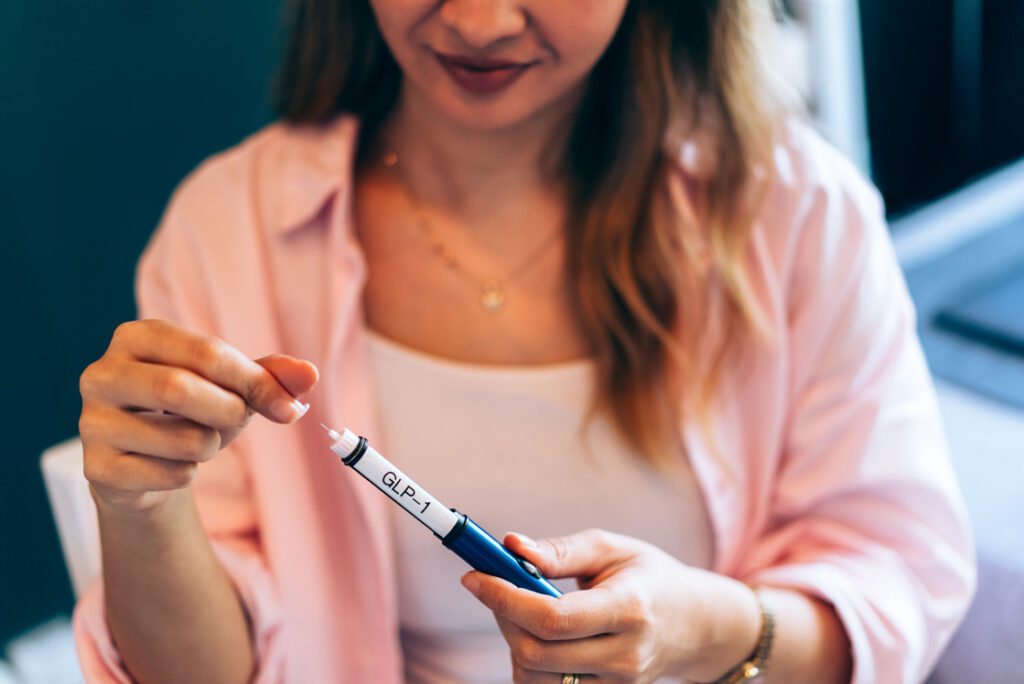
Glucagon-like peptide-1 (GLP-1) is a hormone naturally produced by gut cells after we eat. It works to govern blood sugar and appetite. GLP-1 receptor agonists (GLP-1RAs, most commonly referred to as ‘GLP-1s’) are medications which imitate this hormone. They work by triggering the release of insulin after eating, slowing down digestion, and encouraging the feeling of fullness.
For these reasons, GLP-1s are very effective for weight loss and Type 2 diabetes. In addition, they are being made available by the NHS to help prevent heart attacks and strokes in eligible patients.
Types of GLP-1 medications include:
- Semaglutides like Ozempic and Wegovy
- Tirzepatide (Mounjaro)
- Liraglutide (Saxenda, Nevolat)
GLP-1 medications have been used for treating Type 2 diabetes since the early 2000s. In the years that followed, their potential for weight control became very apparent. This prompted more research and the development of higher dose formulations especially for weight loss, which have proved very effective and popular. In fact, an estimated 1.9 million adults in Great Britain were using weight loss medication in 2026 (UCL), almost three times as many as two years earlier.
This rise matters for anyone thinking about their fertility. Women make up around three quarters of GLP-1 users, and uptake is highest among women in their late thirties – the very years when many are also planning, or actively trying, for a baby. It is little wonder we are increasingly asked how these medications and fertility treatment fit together.
Are GLP-1s good for fertility or bad for fertility?
Use of GLP-1s for weight loss is still new and research is ongoing, but so far we can say that the relationship between GLP-1 and fertility appears broadly two pronged. On the one hand:
GLP-1s may indirectly help fertility by promoting weight loss and fostering better metabolic health.
This is because being overweight or obese can affect hormonal balance and even prevent ovulation in some women. In addition, being overweight can lessen the effectiveness of fertility treatments and raise a woman’s chances of pregnancy complications.
For women who are overweight or obese, weight reduction often helps support fertility.
Many women with Polycystic Ovarian Syndrome/Polyendocrine Metabolic Ovarian Syndrome (PCOS/PMOS) have found GLP-1s particularly helpful because the condition is closely associated with insulin resistance, weight issues and ovulation problems.
There is even some evidence in preclinical studies that GLP-1 medicines may exert beneficial effects on the womb’s inner lining (endometrium) and gonads (ovaries and testicles) directly, and encourage the stimulation of luteinising hormone (a key fertility hormone). However, those are preclinical studies and it is too soon to tell if there are any GLP-1 medication fertility benefits in humans beyond what is linked to the weight loss they promote.
On the other hand:
GLP-1s are not considered safe for use during pregnancy and you should come off them usually 4 to 8 weeks before beginning fertility treatment or trying for a baby. (See below for ‘wash out’ time periods by GLP-1 type).
The UK government Medicines and Healthcare products Regulatory Agency (MHRA) guidance is clear that GLP-1s should not be taken during pregnancy or when you’re about to start trying for a baby.
There is insufficient safety data to determine if taking GLP-1s could harm a developing baby in humans. If you are on a GLP-1 and suspect you could be pregnant, you should speak to your doctor as soon as possible.
To be safe, women of childbearing age who are on a GLP-1 are advised to use contraception.
Importantly, you also need to use contraception for a ‘wash out’ period after stopping a GLP-1 and before trying for a baby. This is because effects can linger in the body (see below for wash-out time periods by GLP-1 type).
Can I have IVF if I’m taking GLP-1 medication?
No, you must come off your GLP-1 for a ‘wash out’ period before you start fertility treatment (see below for wash-out time periods by GLP-1 type).
This is because it still hasn’t been determined whether GLP-1s are safe for use in pregnancy and the medicines can linger in the body. GLP-1s also slow down stomach emptying, creating a risk of regurgitation and blocked airways during sedation for egg retrieval.
If you’re on a GLP-1 and you want to do any of the following, have a conversation with your doctor about coming off your GLP-1 first:
- Trying for a baby
- IVF
- Egg freezing
- Embryo transfer
- IUI
Do I need to stop Ozempic before an egg retrieval?
Yes, you must come off any GLP-1 medication (e.g. Mounjaro, Wegovy, Saxanda) before an egg retrieval – and before starting your fertility treatment (e.g. hormone injections) generally.
GLP-1s are risky for egg retrieval because they slow down stomach emptying, creating a regurgitation or reflux risk that could lead to a blocked airway when you’re sedated. And since GLP-1s remain in the system for a while after you discontinue them, you need to be off them for a defined ‘wash out’ period before fertility treatment (see below for wash-out time periods by GLP-1 type).
How long do I need to be off GLP-1s before starting fertility treatment or trying to get pregnant naturally?
Ultimately you need to speak to your doctor – general guidelines are never a substitute for that. However, the GLP-1 and fertility ‘wash out’ period guidelines from the UK Medicines and Healthcare products Regulatory Agency (MHRA) were as follows in February 2026:
| Semaglutide (Wegovy, Ozempic and Rybelsus) | At least 2 months |
|---|---|
| Tirzepatide (Mounjaro) | At least 1 month |
| Liraglutide (All brands, e.g. Saxenda) | 0 months* |
*Liraglutides leave your system much swifter than the other GLP-1 medicines, which means they should be discontinued just before fertility treatment or trying to get pregnant.
Ready to start planning a family and wondering if your lifestyle is baby-friendly? Want to check if everything’s okay? The Fertility and Gynaecology Academy is one of the UK’s foremost fertility clinics and home to some of the nation’s most experienced fertility experts. We provide guidance, testing, and treatment you can trust.
To book a consultation call The Fertility and Gynaecology Academy now on 020 7224 1880 or email info@fertility-academy.co.uk.
Do GLP-1s affect male fertility or sperm quality?
Dr Bhaskara Kale, Fertility Consultant at The Fertility & Gynaecology Academy says: “Science is still working to understand the association between GLP-1 and male fertility. But much of the research so far suggests GLP-1s may benefit male fertility, particularly in men with obesity and/or type 2 diabetes.”
For example, recent studies have demonstrated that administering GLP-1s to men with obesity may benefit sperm metabolism, motility and insulin secretion. However, more clinical, long-term studies are needed to adequately understand how GLP-1s may impact sperm production, testosterone and fertility outcomes – in both healthy men and men with pre-existing fertility problems. In any case, every patient profile is slightly different.
Key takeaway: Talk with a doctor if you’re a man on a GLP-1 who wants to start trying for a baby or seek fertility treatment, or if you want to have kids in the future and are wondering if GLP-1s might be helpful. Only ever make any changes under medical supervision.